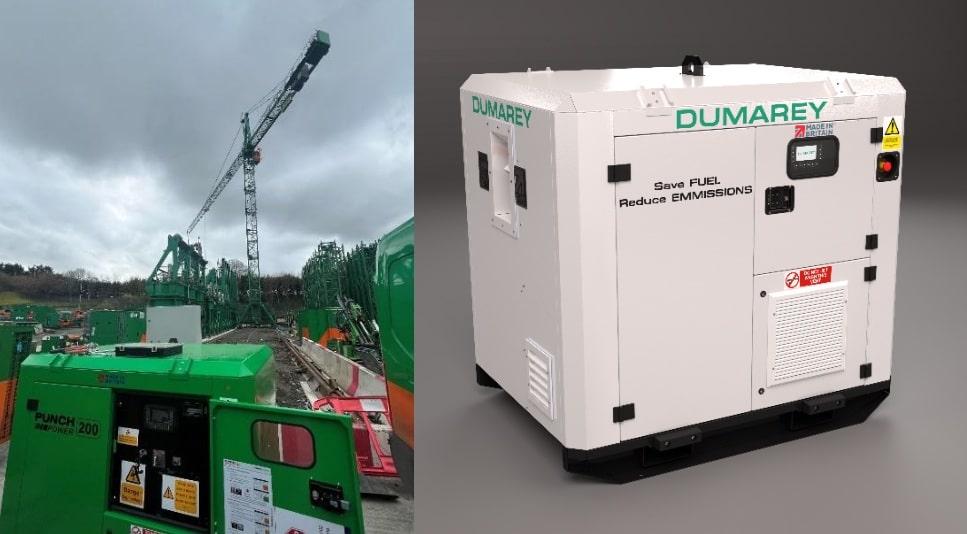
How to find the optimal generator size for a tower crane using Flywheel Energy Storage

Dumarey’s partnership with BAM Ireland

Dumarey deployed a Peak Power 200 flywheel system on a tower crane to enable significant generator downsizing, reducing fuel consumption, operating costs, and emissions.

Clients:

BAM Ireland

Industries:

Construction

Applications:

Tower Cranes

Customer’s benefits

Generator downsized from 220 kVA to 80 kVA, delivering approximately €380 weekly fuel savings and up to 49 tonnes of CO₂ reduction annually.

Customer Requirements

BAM Ireland operates a Wolffkran 7032FL, a 12-tonne capacity tower crane, in a crane storage yard. This crane is mounted on rails with a travelling frame, allowing it to service the entire yard. When powered by diesel generators, BAM typically used a 220 kVA Cummins generator to handle the crane’s dynamic load profile, which includes:

  • High peak demands during lifting and multi-axis movements
  • Variable loads depending on crane operation

This resulted in:

  • Oversized generator usage
  • Inefficient fuel consumption
  • Increased emissions and operating costs

BAM sought to determine whether generator downsizing was possible without compromising crane performance.

Results

The testing demonstrated that significant generator downsizing could be achieved without compromising crane performance:

  • Optimal generator size: 80 kVA (down from 220 kVA)
  • Fuel savings: ~250 litres per week
  • Cost savings: ~€380 per week (using HVO fuel)
  • Emissions reduction: up to 49 tonnes of CO₂ per year (with diesel)

Operational insights showed:

  • Stable crane performance across all test scenarios
  • Effective peak load management by the flywheel
  • Practical limits identified to avoid over-aggressive downsizing

Additional benefits include reduced costs associated with transporting, deploying, and maintaining smaller generators.

Dumarey Solutions

Dumarey deployed the Peak Power 200 flywheel system alongside progressively smaller generators to identify the optimal configuration.
Two approaches to downsizing were considered:

  1. Theoretical calculations based on motor size, start type, and diversity factors
  2. Empirical testing using real crane operations (preferred for more accurate, practical results)

The testing process included:

  1. Replacing the 220 kVA generator with a 110 kVA generator + Peak Power 200
  2. Performing a range of crane operations:
    • Maximum load lifts
    • Maximum speed travel
    • Simultaneous 3-axis movements (hoist, trolley, slew)

The system successfully handled all demands, with data logged remotely and analysed in real time. Further testing was conducted using a 66 kVA generator:

  • All tests were completed successfully
  • However, continuous flywheel support during aggressive manoeuvres indicated excessive downsizing

Final analysis determined that an 80 kVA generator combined with Peak Power 200 provided the optimal balance.

The Peak Power 200:

  • Stores energy during low-demand periods
  • Instantly injects power during peak loads
  • Smooths the generator load profile

Peak Power 200 Flywheel

Delivers instant power to manage dynamic crane loads

Generator Downsizing

Reduces generator size, fuel consumption, and operating costs

Peak Load Management

Ensures performance is maintained during high-demand operations

Operational Efficiency

Improves overall system efficiency and reduces emissions

Results

250

litres of fuel saved per week

380

€ weekly cost savings

49

tonnes of CO₂ avoided per year


    I have read the privacy notice

    Share on

    Error: Contact form not found.

    Error: Contact form not found.

    Error: Contact form not found.


      Error: Contact form not found.

      Error: Contact form not found.

      Error: Contact form not found.

      Error: Contact form not found.

      Error: Contact form not found.

      Error: Contact form not found.

      Error: Contact form not found.

      Error: Contact form not found.

      Error: Contact form not found.

      Error: Contact form not found.

      Error: Contact form not found.

      Error: Contact form not found.

      Error: Contact form not found.

      Error: Contact form not found.

      Error: Contact form not found.

      Error: Contact form not found.