Powering Five Heavy Luffing Cranes Without Diesel: A Hybrid Battery and Flywheel Solution for Large Construction Sites

Dumarey and Zenobē Partner to Decarbonise Multi-Crane Construction Site

Dumarey Green Power supplied a major UK contractor a hybrid power solution combining a PowerSkid second-life battery energy storage system and a Peak Power 200 flywheel system to power five Terex CTL-630 luffing jib cranes.

Clients:

A major UK contractor
Large UK construction site

Industries:

Construction

Applications:

Tower Cranes

Customer Benefits

The hybrid set up replaced five 500kVA generators and five 100kW loadbanks and powering the site with grid power. Total savings add up to £750,000 per year.

Customer Requirements

In this case study, a major UK contractor, in partnership with Zenobē and Dumarey Green Power, deployed a hybrid power solution combining PowerSkid second-life battery energy storage systems (BESS) and Peak Power 200 flywheels to power five Terex CTL-630 luffing-jib cranes. This innovative approach optimised battery size, reduced costs by over £750,000 per year, and achieved a 98% reduction in CO₂ emissions compared to traditional diesel generators. The case study showcases how Dumarey Green Power’s technologies can be integrated to deliver sustainable, high-performance power for construction sites.

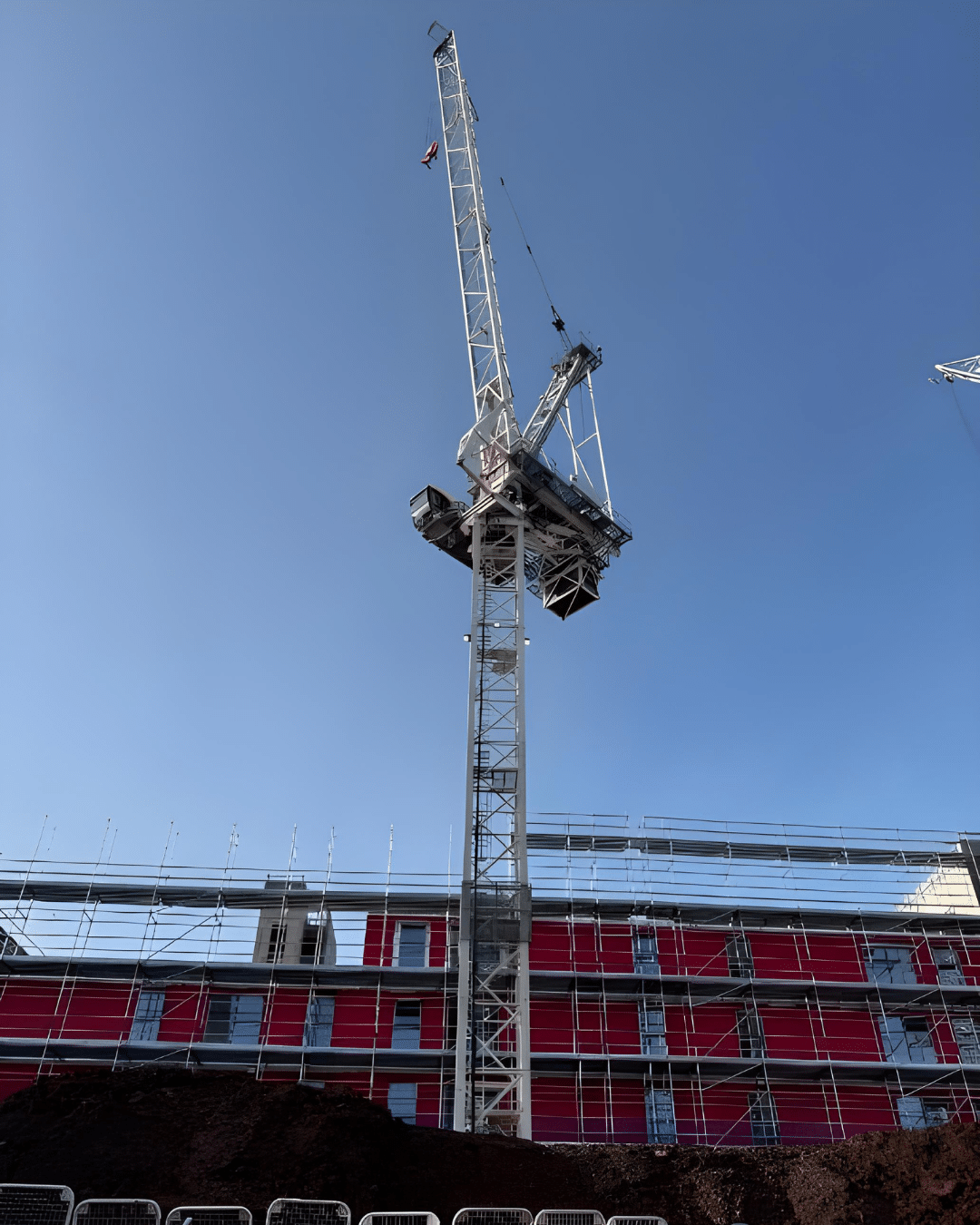
The Terex CTL-630 Crane

The Terex CTL-630 is a heavy luffing-jib crane with a maximum lifting capacity of 32 tonnes. It features two primary electric motors – one for hoisting the load and one for luffing the boom, plus smaller motors for slewing. The crane’s peak power demand, accounting for simultaneous motor operation and high starting currents, is approximately 310kVA (263.5kW at a power factor of 0.85). Traditionally, each crane requires a 500kVA diesel generator to handle these peaks in power, leading to significant fuel consumption and emissions due to low average loads and idle losses.

Challenges with Diesel Generators

Tower cranes typically have low daily energy consumption (around 70–100kWh/day) but high peak power demands, making them challenging to power sustainably. Modern Stage V diesel generators struggle with low average loads, causing issues with diesel particulate filters (DPFs) and selective catalytic reduction (SCR) systems. To mitigate underloading, operators often use 100kW loadbanks, which consume excessive diesel and increase emissions. For the five cranes, this setup consumed approximately 2,400 litres of diesel per 70-hour workweek, emitting significant CO₂, NOx, and SOx.

Results

Before the hybrid system, each crane was powered by a 500kVA diesel generator with a 100kW loadbank to prevent underloading. This setup consumed 2,400 litres of diesel per 70-hour workweek across five cranes (480 litres/crane/week). Using the UK emissions factor for diesel (2.687 kg CO₂e/litre, 2023), the cranes emitted:

2,400 litres × 2.687kg CO₂e/litre=6,448.8kg CO₂e/week = 6.45 tCO₂e/week

Total emissions for five cranes were approximately 32.24 tCO₂e/week, with additional NOx and SOx from loadbank and idle losses.

With the BESS-flywheel system, each crane consumed approximately 100kWh/day, including 30kWh of parasitic losses (including flywheel operation, BESS cooling) and 70kWh for crane activity. For five cranes over a 5-day workweek (70 hours): 100kWh/day/crane × 5 days × 5 cranes = 2,500kWh/week

Using the UK grid emissions factor (0.207 kg CO₂e/kWh, 2023): 2,500 kWh/week×0.207 kg CO₂e/kWh=517.5 kg CO₂e/week=0.518 tCO₂e/week

Savings Achieved:

  • Cost: At £0.24/kWh for mains electricity, the weekly energy cost was: 2,500 kWh/week x £0.24 = £600 per week
    Compared to £15,000/week for diesel (2,400 litres x 5 cranes x £1.25/litre, adjusted for 2025 fuel prices), this saved £14,400/week
  • Emissions dropped from 32.24 tCO₂e/week to 0.518 tCO₂e/week, a 98.4% reduction (31.72 tCO₂e/week saved)
  • Additional Savings: removing five 500kVA generators and loadbanks saved significant hire costs (estimated £2,000–£3,000/week). Combined with fuel and emissions savings, the site projects annual savings of approximately £750,000

Sustainability and Scalability

The use of second-life batteries reduced embodied emissions, while mains charging leveraged the UK’s decarbonising grid (projected to fall below 0.15kg CO₂e/kWh by 2030). For sites with renewable energy contracts, market-based emissions could approach 0kg CO₂e/kWh. For off-grid sites, pairing BESS with small Stage V generators could maintain low emissions.

Dumarey Solutions

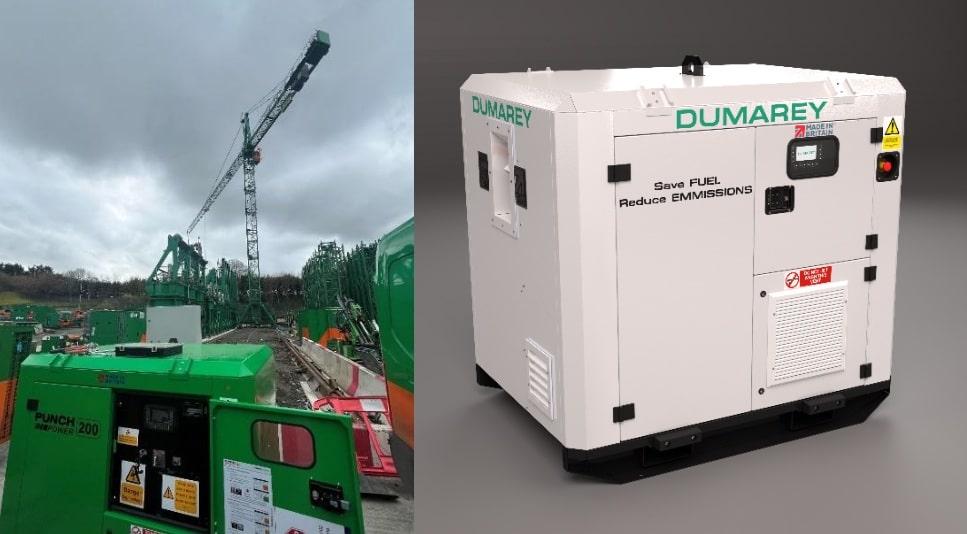
Battery energy storage systems (BESS) offer a low-loss alternative to diesel generators, with minimal idle losses and high efficiency. Initially, the site considered 300kVA / 300kWh BESS units, each housed in 10’ containers and weighing over 10 tonnes. However, Zenobē, and Dumarey proposed a more compact and cost-effective solution: a hybrid system combining a 100kW PowerSkid BESS with a Peak Power 200 flywheel per crane. This combination delivered up to 260kVA (220kW) of peak power, provided power factor correction, and reduced system weight and footprint by 50% compared to an expensive 300kWh BESS.

The PowerSkid is an industrial BESS utilising “second-life” battery modules from electric vehicles, reducing embodied emissions and supporting a circular economy. Each PowerSkid has a continuous rating of 100kW, a peak output of 160kW, and a capacity of 240kWh. Using an industrial inverter, it produces a stable 3-phase AC grid, ideal for crane operations. The system’s compact design and lower weight (less than 4.5 tonnes) enhance site logistics and deployment flexibility.

The Peak Power 200 is a flywheel energy storage system designed for rapid power delivery and peak lopping. It can deliver up to 85kW (approximately 100kVA at 400V) within 20 milliseconds of detecting a load, effectively handling the crane’s starting surges (up to 310kVA). The flywheel’s energy storage capacity is limited, but its high cycle life and fast response make it ideal for short-duration peak demands. Configured to maintain the PowerSkid’s load below 160kW, the flywheel also provides power factor correction, ensuring a power factor of 0.95 or better for maximum system efficiency.

While BESS can be charged using small diesel generators in off-grid scenarios, this site leveraged a 63A (45kVA) mains feed per BESS for overnight charging. Each PowerSkid was fully charged in approximately 4 – 5 hours (accounting for charging efficiency of 90%), using 35 – 40kWh of grid electricity per hour. Charging was scheduled outside working hours (e.g., 10 PM – 6 AM), freeing the mains supply for other site equipment during the day. This strategy maximised the use of limited grid capacity and eliminated the need for on-site generators.

PP200

High Power low energy energy storage system, ideal for tower cranes

PowerSkid

Second-life EV battery BESS system, low embedded CO₂, high storage capacity and high power.

Small Mains Supply Charging

The system replaced a diesel generator with a small 3-phase mains supply

Displacing Diesel Generation

London has strict emissions control requirements for diesel generators, this hybrid set-up helps sites meet their obligations

Results

2400

litres of diesel saved each week

>64

tonnes of CO₂ avoided each week

0

zero noise
on site emissions, fuel deliveries


    I have read the privacy notice

    Share on

    Error: Contact form not found.

    Error: Contact form not found.

    Error: Contact form not found.


      Error: Contact form not found.

      Error: Contact form not found.

      Error: Contact form not found.

      Error: Contact form not found.

      Error: Contact form not found.

      Error: Contact form not found.

      Error: Contact form not found.

      Error: Contact form not found.

      Error: Contact form not found.

      Error: Contact form not found.

      Error: Contact form not found.

      Error: Contact form not found.

      Error: Contact form not found.

      Error: Contact form not found.

      Error: Contact form not found.

      Error: Contact form not found.