How to start and power a Hybrid Jaw Crusher on a Downsized Generator using Flywheel power factor correction

Dumarey’s partnership with Keestrack (with Fredheim Maskin AS, Rapid Power Generation, Mecc Alte UK)

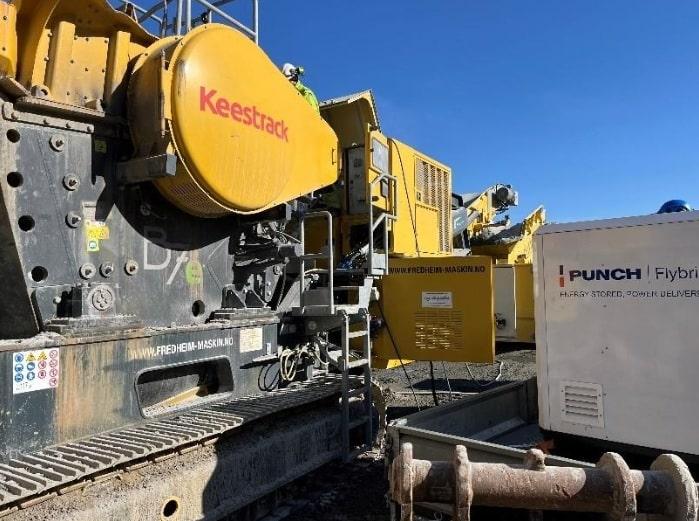
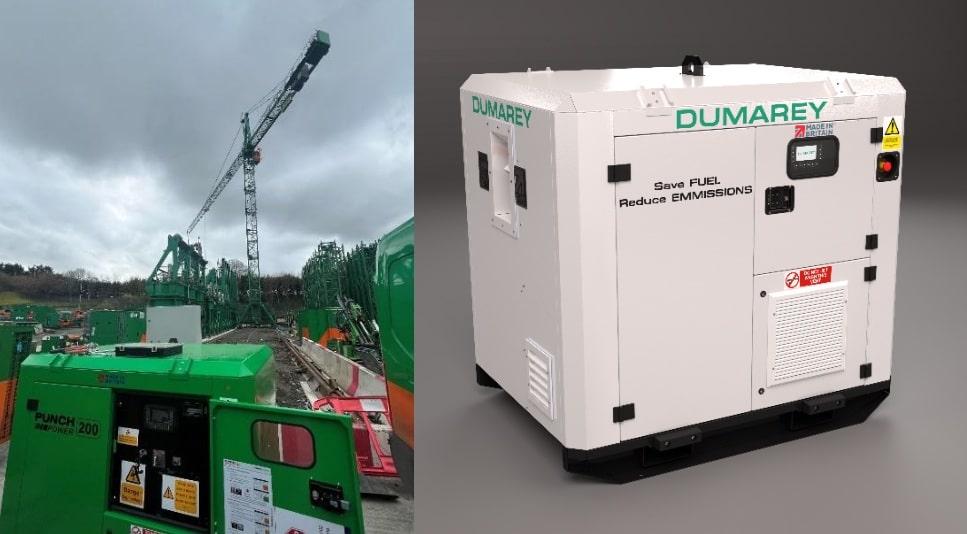
Dumarey deployed a Peak Power 200 flywheel system on a hybrid jaw crusher to enable generator downsizing and load levelling, reducing fuel consumption, emissions, and equipment stress.

Clients:

Keestrack

Industries:

Mining and Quarrying

Applications:

Jaw Crushers and Screening Equipment

Customer’s benefits

Generator downsizing from 330 kVA to 250 kVA, delivering approximately 6,000 litres annual fuel savings and around 17 tonnes of CO₂ reduction, while improving generator stability and reliability.

Customer Requirements

The Keestrack B7e is a heavy-duty hybrid jaw crusher that can operate using either:

  • An integral 330 kVA diesel generator
  • External power supply

Rock crushers exhibit highly dynamic load profiles, characterised by:

  • Sharp power spikes when material enters the crusher
  • Reduced demand as material passes through

This results in:

  • Oversized generators to handle peak loads
  • Poor efficiency at partial load
  • Increased fuel consumption and emissions
  • High stress on generator components

Additionally, starting the crusher presents a major challenge due to high reactive power demand, even with soft-start systems in place.

Results

The deployment demonstrated both generator downsizing and effective load levelling:

  • Crusher successfully started with a 250 kVA generator (vs. 330 kVA)
  • Peak load of 332.4 kW reduced to 247.4 kW from the generator
  • Remaining peak demand supplied by the flywheel

Key benefits include:

  • Fuel savings: ~6,000 litres per year
  • Emissions reduction: ~17 tonnes of CO₂ per year
  • Improved generator efficiency and stability
  • Reduced mechanical and electrical stress on alternators

Additional operational insights showed:

  • Smooth and stable power delivery despite highly dynamic loads
  • Reduced wear leading to lower maintenance requirements
  • Improved reliability of the overall power system

Dumarey Solutions

Dumarey deployed the Peak Power 200 flywheel system in two phases:

Phase 1: Generator Downsizing
An initial test attempted to start the crusher using a 250 kVA generator alone:

  • The generator shut down due to overcurrent protection
  • Power factor dropped as low as 0.18
  • Reactive power demand exceeded 600 kVAr

The Peak Power 200 was then introduced:

  • Power factor correction was enabled
  • The flywheel stabilised voltage and reduced reactive demand
  • The crusher was successfully started using the 250 kVA generator

This demonstrated that generator downsizing was achievable when supported by the flywheel system.

Phase 2: Load Levelling on Site
At a live operating site, the Peak Power 200 was connected to:

  • The crusher’s integral 330 kVA generator
  • An additional Keestrack K7 screening unit

The flywheel system was configured to:

  • Supply power during peak demand
  • Absorb energy during low-load periods
  • Smooth fluctuations in generator loading

Optimal system tuning identified a load levelling setpoint of 175 kW.

The Peak Power 200:

  • Responded dynamically to load changes (up to 1.5 times per second)
  • Performed continuous power factor correction
  • Reduced stress on generator components

Peak Power 200 Flywheel

Provides instant real and reactive power for highly dynamic industrial loads

Generator Downsizing

Enables smaller generators without compromising performance

Load Levelling

Stabilises generator output and improves efficiency

Power Factor Correction

Reduces reactive power demand and improves system performance

Improved Equipment Reliability

Reduces stress on alternators and extends service intervals

Results

6.000

litres of fuel saved per year

17

tonnes of CO₂ avoided per year

-80

kVA
Generator downsized


    I have read the privacy notice

    Share on

    Error: Contact form not found.

    Error: Contact form not found.

    Error: Contact form not found.


      Error: Contact form not found.

      Error: Contact form not found.

      Error: Contact form not found.

      Error: Contact form not found.

      Error: Contact form not found.

      Error: Contact form not found.

      Error: Contact form not found.

      Error: Contact form not found.

      Error: Contact form not found.

      Error: Contact form not found.

      Error: Contact form not found.

      Error: Contact form not found.

      Error: Contact form not found.

      Error: Contact form not found.

      Error: Contact form not found.

      Error: Contact form not found.